Dryer Not Heating? Causes, Checks, and Parts to Replace
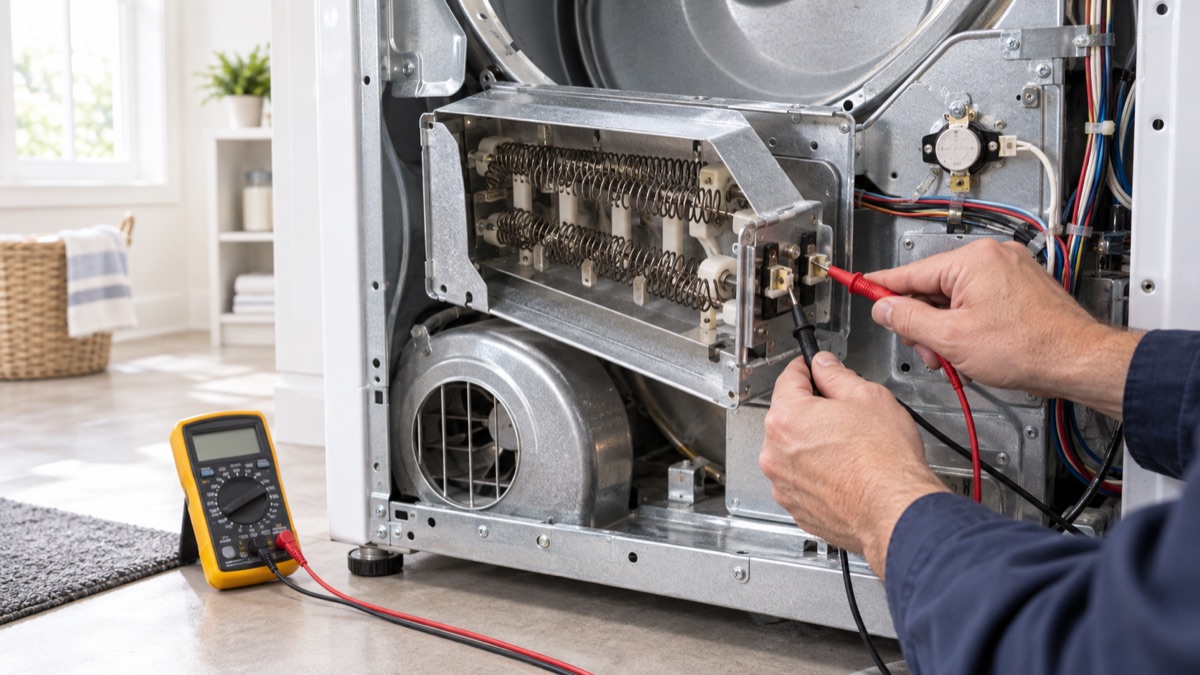
When a dryer is not heating, the drum turns but the clothes come out cold and damp. Usually, a blown thermal fuse, a bad heating element, or a failed igniter is the cause. First, clear the vent, since a blockage often trips the fuse. Then, work through the heat parts below.
Parts to inspect for a dryer not heating problem
1. Heating Element
The heating element warms the air that dries your clothes on an electric dryer. When the coil burns out or shorts, the drum turns but the air stays cold. Therefore, test the element for continuity and look for a broken or sagging coil. Replace the element if it is open or grounded to the housing.
2. Gas Valve Coils
The gas valve coils open the burner valve so gas can flow and ignite. When a coil weakens, the igniter glows but the burner never lights or drops out early. So test the coils and watch whether the flame holds. Replace the coil set if the burner will not stay lit.
3. Igniter
The igniter glows hot to light the gas at the burner on a gas dryer. When it cracks or burns out, there is no flame and no heat. Therefore, check that the igniter glows during a cycle and test it for continuity. Replace the igniter if it stays dark or reads open.
4. Radiant Flame Sensor
The radiant flame sensor detects the igniter’s heat and tells the control to open the gas. When it fails, the burner will not light or cycles wrong. So test the sensor for continuity at room temperature. Replace it if it does not read closed, since a bad sensor blocks ignition.
5. Thermal Fuse
The thermal fuse cuts power if the dryer overheats, usually from a blocked vent. When it blows, the dryer may go dead or run without heat. Therefore, test the fuse for continuity and clear the vent that tripped it. Replace the fuse, but always fix the airflow first, or the new one will blow too.
6. High-Limit Thermostat
The high-limit thermostat is a safety switch that opens if the heater box gets too hot. When it trips or fails, you lose heat or the dryer shuts down. So test the thermostat for continuity and check the vent for a blockage. Replace it if it stays open, and clear the airflow that caused it.
7. Cycling Thermostat
The cycling thermostat turns the heat on and off to hold the drum at the set temperature. When it sticks, the dryer runs cold, stays too hot, or dries unevenly. Therefore, test the thermostat for continuity and correct switching. Replace it if it does not open and close at temperature.
8. Timer & Electronic Control Board
The timer or control board runs the cycle and powers the heater, motor, and valves in turn. When it fails, the dryer may not heat, advance, or start. So confirm the control steps through the cycle and powers each output. Replace the timer or board if it stalls or stays dead.
Get the parts
We supply OEM and replacement parts in bulk. Browse the Appliance Parts catalog, or request a bulk quote for volume orders.
Is the unit old or failing often? A new ENERGY STAR certified dryer can cut energy use, so weigh a repair against a replacement.
Most of the time, a dryer not heating problem traces back to one worn part. So replace it, then run a short cycle and confirm the fix.