Freezer Not Working? Why It Will Not Start
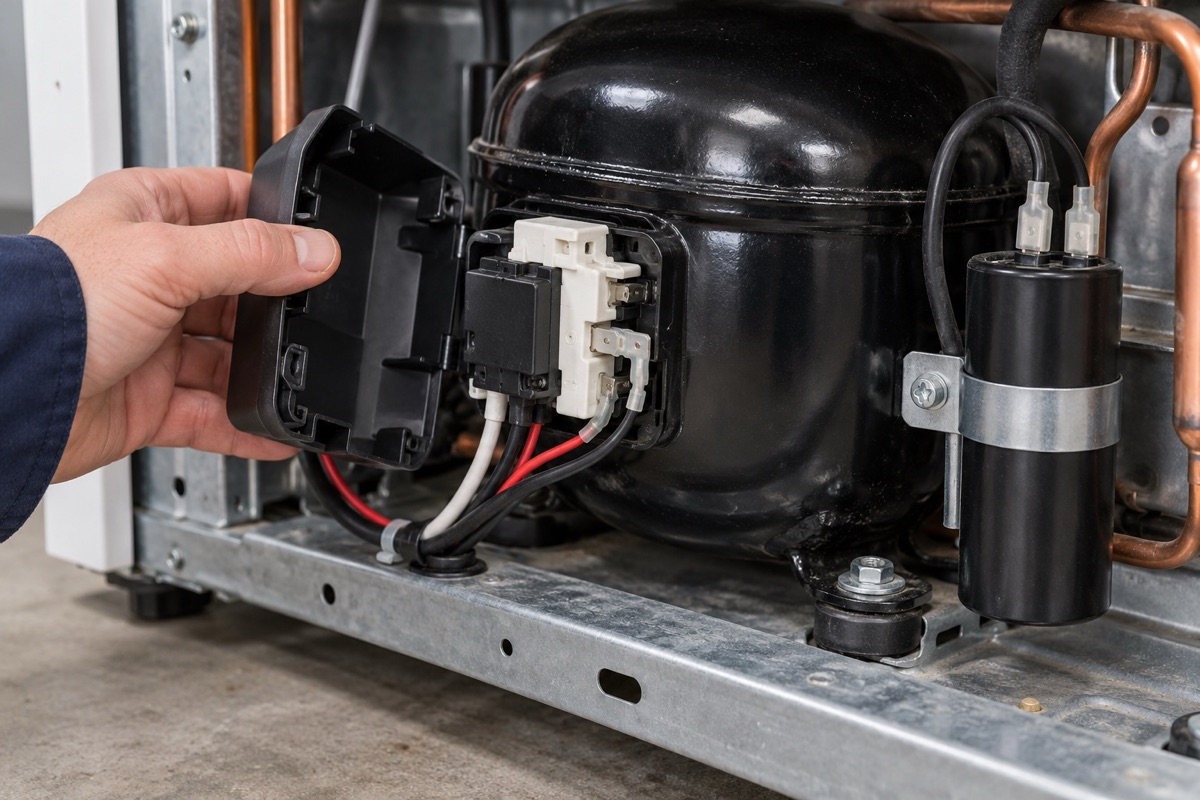
A freezer not working means the compressor will not start, so the cabinet slowly warms to room temperature. Usually, a failed start relay, a bad control board, a stuck thermostat, or a weak start capacitor is the cause. First, confirm the outlet has power. Then, work through the start circuit and the controls below.
Parts to inspect for a freezer not working
1. Start Relay or Controller
The start relay, often a PTC device, feeds the compressor start winding for the moment it needs to get turning. When the relay fails, the compressor only hums or clicks and then shuts off on its overload. Therefore, unplug the freezer and shake the relay, since a rattle points to a failed part. Replace the relay if it is burned, rattles, or will not pass continuity, because a bad relay is a frequent no-start cause.
2. Electronic Control Board
The electronic control board runs the freezer, reads the sensors, and switches the compressor and defrost circuits. When it fails, the freezer may not start, may skip defrost, or may ignore the controls. So look for burnt spots and relays that will not click, and confirm the board sends power to each output. Replace the board if it no longer drives the compressor on a cooling call.
3. Temperature Control or Thermostat
On a no-start, confirm the control is calling for cooling and not stuck open. The temperature control, often a cold control thermostat, senses the freezer temperature and switches the compressor on and off to hold the set point. When it fails, it may keep the compressor off, so the freezer warms, or hold it on, so the freezer runs cold. Therefore, turn the dial through its range and listen for the switch to click. Test it for continuity, and replace the control if it will not pass power at a cold setting.
4. Start Capacitor
The start capacitor gives the compressor motor an extra push so it can start under load. When it weakens or shorts, the compressor struggles to start, hums, or trips its overload. Therefore, leave this part to a technician, because a capacitor can hold a charge and must be discharged before testing. Replace the capacitor only after it is safely discharged and tests out of its rated range.
5. Defrost Timer
On some models a failed timer can interrupt the compressor circuit, so check it on a no-start. The defrost timer cycles the unit between normal cooling and a short defrost period that clears the evaporator coils. When it sticks in cooling, frost packs the coils until airflow drops. When it sticks in defrost, the compressor never runs. Therefore, advance the timer by hand and watch the unit switch modes. Replace the timer if it will not move the unit out of a mode on its own.
Confirm power before you open the freezer
Before you condemn a part, make sure power reaches the freezer. First, test the outlet with another appliance or a meter. Then, check the cord and the house breaker. Next, listen at the compressor for a hum or a click that then cuts out, which points to the start relay. Because a dead outlet looks just like a dead freezer, this check comes first.
Get the parts
We supply OEM and replacement parts in bulk. Browse the Appliance Parts catalog, or request a bulk quote for volume orders.
Is the freezer old or failing often? So weigh a repair against a new unit, and browse complete freezers and refrigerators when a replacement makes more sense.
Most of the time, a freezer that is not working or will not start traces back to one worn part. So replace it, then run a short cooling test and confirm the fix.